|
JK: "When you do your first album, it's the only thing in your life. Life In A Day
was a colossal disappointment to us, though we didn't realise that until a week after we'd finished.
The demos were really good. John Leckie
was great, but it was all wrong. We decamped to London - we were in Abbey Road and we came out with
a very professional-sounding record. On the drive home to Scotland, someone gave me a copy of Unknown Pleasures
by Joy Division. We thought we were edgy, because we were influenced by Patti Smith,
Iggy Pop and Lou Reed. After listening to Unknown Pleasures our record sounded
like The Boomtown Rats. With the greatest of respect, that wasn't what we wanted."
Record Collector Interview
Record Collector #364
July 2009
|
- "We had songs like Pleasantly Disturbed and
Chelsea Girl. A local reporter called
Billy Sloan told us: 'This is going to happen!' We felt we were much better
than we should have been. We were learning as we went along."
- The working title of the album was Children Of The Game (a Jean Cocteau reference).
Although this working title was dropped, a song was eventually
recorded with that title.
- It was changed to Life In A Day after the band wrote the title song
whilst selecting and rejecting material in a barn near Edinburgh in January 1979.
- Their first choice of producer was John Cale. Arista vetoed this suggestion.
- Their second choice was John Anthony, who'd produced Van Der Graff Generator and others. Again, this was vetoed.
- But Arista did allow their third choice, the legendary John Leckie.
- The album was recorded in the grounds of Farmyard Studios at Little Chalfont using the
The Mobile Studio, an ex-army mobile unit owned by The Rolling Stones. It was freezing in this
huge truck - hence the sly footnote on the inner-sleeve: "Recorded at a very low temperature."
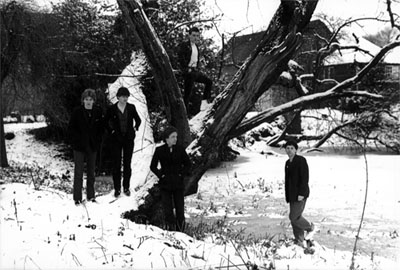
- Pictures of the band in the grounds of the studio show just how cold it was.
- The songs were recorded on multi-tracks from the 28th January in the following order:
Wasteland (first take, incomplete and left undocumented on the tones reel),
Life In A Day,
Rosemary's Baby (incomplete and left as an instrumental),
Someone (an abandoned slower-tempo first take),
Wasteland (the second take),
Pleasantly Disturbed,
Sad Affair,
Murder Story,
Special View,
Someone (second take) and two takes of
Chelsea Girl (neither of which made the grade).
- Mixing commenced at The Townhouse at the start of February with work on Life In A Day and
Chelsea Girl. Unfortunately most of the session tapes from February have been lost or reused, so the
recording history of most of the album has gone.
- With Rosemary's Baby rejected and Special View pencilled in
as a B-side, the band realised they were short of material, and had to draw on further songs
from their live repertoire. Therefore a
stripped down and rearranged version of Sweet Things was committed to multi-track
along with two new ideas: All For You which was developed and recorded for
the final album; and Children Of The Game which remained an
incomplete backing track.
- Mid-February they moved to Abbey Road where recording and mixing continued. This included recording an
orchestra, with an arrangement by Haydn Bendall, for Pleasantly Disturbed;
and the use of the studio's harpsicord for a third, and successful, take of Chelsea Girl.
(Derek Forbes called up everyone he knew, enthusing that he'd played
the actual harpsicord used on Sgt. Peppper).
- Between the 19th and 23rd of February,
Leckie assembled a rough mix of the album at The Townhouse. Songs almost
in their final form included Someone, All For You,
Chelsea Girl, Life In A Day and
Pleasantly Disturbed.
- The rough of Pleasantly Disturbed was particularly interesting as it was missing some of its orchestration so
Mick filled in the gaps with some unique new keyboard melodies. The song was finished
the next week when the final mix was produced.
- By the last week of February, the recording was finished. Simple Minds
appeared on The Old Grey Whistle Test and returned to Scotland to prepare for the tour.
John Leckie remained at The Townhouse and tidied up the session tapes,
compiling several reels of out-takes. (These out-takes were very, very close to the final mixes although
No Cure featured more saxophones).
- The album sessions yielded the full album, the B-side Special View and
two unfinished out-takes: Rosemary's Baby and
Children Of The Game.
- The album's master tape was created on the 4th March 1979 at The Townhouse. Production masters were
made over a week later at Abbey Road Studios on the 12th March 1979.
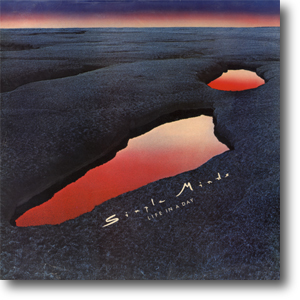
- The album's artwork was by Carole Moss, a friend of John Leckie.
The front cover was a colourised black-and-white shot of the salt marshes at Morecambe Bay. She also took the band
out for a photo session at a derelict manor house which included pictures of the band posing outside and
inside (especially with everyone awkwardly posed around the staircase). It wasn't a good shoot and the photographs
were rejected. Instead, she took portrait shots of each band member, shots of the interior of The Mobile Studio, and
combined the two for the inner sleeve artwork.
- Journalist, and Zoom press officer, Brian Hogg designed
the tambourine labels on the original LP pressing.
- It was released on the Zoom record label (the only album to be released through the independent) on LP and
cassette. The album included an inner sleeve with Carole Moss's band portraits, interiors of The Mobile Studio,
and handwritten label copy. (The style of the handwriting could've been by either Jim's or
Brian Hogg). Some copies of the LP may have included posters.
- The album track listing was finalised in mid March - this reel-to-reel copy master from early in the month reveals a different
track ordering. Test pressings of the album were also distributed with slightly different artwork.
- The album was licensed through Arista/Ariola throughout Europe and
PVC Records in the USA. PVC decided to change the artwork, making the title easier to read.
- Life In A Day and Chelsea Girl were selected as singles.
- The band hated the final result and quickly disowned the album, despite parent label
Arista being pleased with its chart placing.
- A couple of days after completing the album, Jim heard Unknown Pleasures by Joy Division, prompting
him to phone Bruce Findlay and ask if the release could be cancelled,
and the album re-recorded. Bruce expained that Arista were pleased with
the album and the release would go ahead as planned.
- "I have bittersweet emotions about that first album. Incredibly exciting, obviously. We were just starting to get a wee bit clever.
We got a new keyboard in and he brought lots of frills and hooks. We got the deal, very exciting, John Leckie,
the producer we wanted to work with even though we didn't know what a producer did, he'd worked with all these bands like
XTC, Magazine... I remember at the time, the result sounded professional, sounded impressive, but I
privately felt there was something not quite right with it which I couldn't articulate. No one else was saying anything, but we went to
press it, got the acetates, and as we were about to drive up to Scotland, someone gave me a cassette of
"Unknown Pleasures" by Joy Division and I thought, we've completely blown it. Our live stuff, our demos were a bit darker,
more hints of the Velvets, etc, and no hint at all of The Boomtown Rats! I wanted to scrap it, make it again, but
I think we'd played the songs to death by the time we brought them to the studio, played around with them, got a bit clever with them and
didn't reproduce them in their raw state." - Jim.
- However, as a compromise, Bruce said they could record
their next album in the next couple of months.
- Virgin aquired the rights to the album when they purchased Simple Minds' back catalogue in
1982. Life In A Day was reissued on the label's mid-price range as a
LP (Virgin VM6) and a MC (Virgin VMC6). These
were basic reprints of the Arista originals although the inner sleeve and unique label designs of the record were ditched.
A further pressing was produced in August 1984 after the success of Sparkle In The Rain,
this time on Virgin's budget OVED range.
- In 1986, Virgin finally issued the album on CD. This caught out one reviewer,
who assumed it was the follow-up to Once Upon A Time. He commended
Simple Minds on their brave new direction.
|
"...I think we were in Aberdeen on the morning of that release and just seeing our debut album sleeve
in the window of record stores was a thrill never to be forgotten. A new kind of pressure was suddenly
on however and being novices to the game we started to feel it immediately."
"Unavoidably real, it was the pressure of now having to compete commercially. To show that we could sell
enough albums to maintain the on - going faith and investment of our record company.
As for the live shows? It felt like we had a crusade on our hands. A crusade that involved getting our
music heard to the world at large."
Jim, 27th May 2019
|
- The album was remastered in 2002 as part of an extensive Virgin campaign.
It was released as a limited edition vinyl replica CD and standard edition CD. This version remains on catalogue.
|

|