- The band were desparate to quickly record the successor to Life In A Day in an attempt to bury it.
"We were so anxious to see Life In A Day in the shops,
it was almost embarrassing. And afterwards we wanted it out, that's why we were so quick to produce follow-up." - Jim.
- The legend states that they entered the studio with nothing written nor demoed, with the entire album conceived within the walls of
Rockfield Studios, Wales. However, the band had been playing early versions of
Calling Your Name and
Scar during the
Life in A Day tour, whilst
Naked Eye had been recorded for a
Piccadilly Radio session.
- Premonition had also appeared live, and the band had also written
Carnival (Shelter In A Suitcase) and
Real To Real.
- Producer John Leckie remembered
Derek Forbes had the riff for
Changeling before entering the studio. This statement was later contradicted by
Jim who recalled recording a 4-track demo of
Changeling with
Charlie and
Mick.
- Gary Numan was pencilled in as a potential producer, but the band elected to stay with
John Leckie who'd produced the previous album
Life In A Day.
- Bruce, writing in
Cripes #108, mentioned that the band recorded 13 songs. The left over song is assumed
to be Kaleidoscope.
- It was recorded in five weeks.
- The studio next door was being used by Iggy Pop. He was recording Soldier, being helped out by
David Bowie. The band wanted Bowie to play sax
on the album, but no-one could pluck up courage to ask him. Spotting them handing around, Bowie
asked if they could sing, gave them lyric sheets, and
Simple Minds ended up as backing vocals on Play It Safe and others.
- Originally intended to be the second Zoom album, Bruce's catalogue suggestion of
ZULP 2 was met shrugs from Arista. It turned out it would be too problematic to program the computers. By this point,
Bruce was putting Zoom Records into cold storage and forming
Schoolhouse Management so it became a mute point. As Simple Minds were still
signed to Zoom (on paper), all subsequent singles and albums were released on a 'special' Zoom Arista
label.
- Although as far as Bruce was concerned, it was an Arista album.
- The band refused to demo the album. Or let Arista executives hear work in progress. On the first playback,
it was met with complete silence and the immortal phrase: "Jesus! Where's the Chelsea Girl?."
- Arista lost faith in the band; the album was quietly released in November, and the only
single, Changeling, slipped out in the immediate post-Christmas period. Both failed
to chart.
- Tenative plans to release Carnival (Shelter In A Suitcase) as a single
were then shelved.
- However, it got far better reviews than Life In A Day. Paul Morley listed it
in his "Top Ten Records Of The Year."
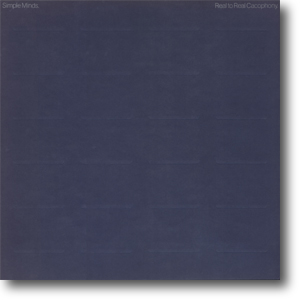
- Unhappy with the artwork for Life In A Day, Arista commissioned
their in-house designer, Paul Henry, to come up with the artwork. The plan backfired spectacularly; not only
did they hate the new, dull blue textured sleeve even more, it turned out to be wildly expensive to produce.
- An inner sleeve was also required to carry track information and production credits.
- The original sleeves were thermographic, featuring a sequence raised bumps and textures. Trying to cut costs,
the second issues were packed in plain card sleeves without the texturing. Virgin, when issuing the album,
have always dodged the issue, packaging the album in a glossy sleeve. Which is always the wrong shade of blue.
- Finally, a word to any record company planning a reissue. The title is: Real To Real Cacophony. Not
Reel To Real Cacophony. Nor Real To Reel Cacophony. Or even, the final permutation,
Reel To Reel Cacophony. The album has been repeatedly released with the wrong title. The correct one?
It's Real To Real Cacophony.
|


|